

Table of Contents
- 1. Understanding Porcelain Inlays and Onlays and Why They Matter
- 2. Superior Aesthetics That Blend Seamlessly with Natural Teeth
- 3. Exceptional Durability and Longevity Compared to Traditional Fillings
- 4. Precision Digital Technology Ensures Perfect Fit Every Time
- 5. Conservative Tooth Preservation Through Minimally Invasive Treatment
- 6. Cost-Effective Long-Term Solution for Moderate Decay Restoration
- 7. Quick One-Visit Placement with Our Advanced CEREC Technology
- Frequently Asked Questions (FAQ)
1. Understanding Porcelain Inlays and Onlays and Why They Matter
Porcelain inlays and onlays are custom-crafted restorations that replace the damaged or decayed portion of your tooth with tooth-colored ceramic material. The difference between the two is straightforward: an inlay fits within the cusp tips of the tooth (the pointed ridges), while an onlay extends over one or more of those cusps to provide additional coverage and strength.
Think of them as the middle ground between a simple filling and a crown. When you have moderate decay or damage that affects a larger area than a filling would handle, but your tooth still has substantial healthy structure intact, inlays and onlays offer the ideal solution. Unlike crowns, which require removing significant tooth structure, inlays and onlays preserve the maximum amount of your natural tooth while restoring full function and beauty.
At our North Miami Beach practice, we customize each restoration to fit your tooth perfectly. The result is a restoration that bonds directly to your tooth, strengthens it, and blends seamlessly with your smile. Whether you’re dealing with decay on a back molar or damage on a visible tooth, these restorations provide reliable, long-lasting results without compromise.
Your action step: Schedule a consultation to discuss whether an inlay or onlay is right for your situation. Dr. Edderai will examine your tooth and recommend the restoration that best preserves your natural structure while delivering the strongest, most beautiful outcome.
2. Superior Aesthetics That Blend Seamlessly with Natural Teeth
The moment you smile, people notice your teeth. A dark silver filling visible on a back tooth or a mismatched restoration on a front tooth can undermine your confidence. Porcelain inlays and onlays solve this problem completely.
Because they’re crafted from tooth-colored ceramic, they match your natural enamel precisely. Our lab technicians shade each restoration to blend perfectly with your existing teeth, accounting for the natural color variation and translucency of your smile. Whether your teeth are bright white or have warmer undertones, your inlay or onlay will integrate so seamlessly that you and others will struggle to identify where the restoration begins and your natural tooth ends.
This aesthetic advantage matters deeply for visible teeth. A porcelain restoration on a front molar or bicuspid won’t catch light with the metallic glint of old amalgam fillings. On front teeth, the difference is even more dramatic: porcelain reflects light the same way your natural enamel does, creating a unified, radiant smile.
Beyond color matching, the smooth ceramic surface of a porcelain inlay or onlay resists staining far better than composite resin fillings. Years from now, your restoration will maintain its brightness and clarity while lesser materials darken or develop surface stains. When you invest in your smile, you deserve a restoration that stays beautiful for decades.
Your action step: Bring photos of your smile during your consultation. This helps us discuss exactly where your restoration will be placed and show you previews of how your smile will look improved.
3. Exceptional Durability and Longevity Compared to Traditional Fillings
Traditional amalgam fillings typically last 7 to 10 years before they need replacement. Composite resin fillings often fail even sooner, typically within 5 to 7 years. Each time you need a replacement, more of your tooth structure is removed, and the new restoration is often slightly larger than the one it replaces. Over multiple cycles, very little of your original tooth remains.
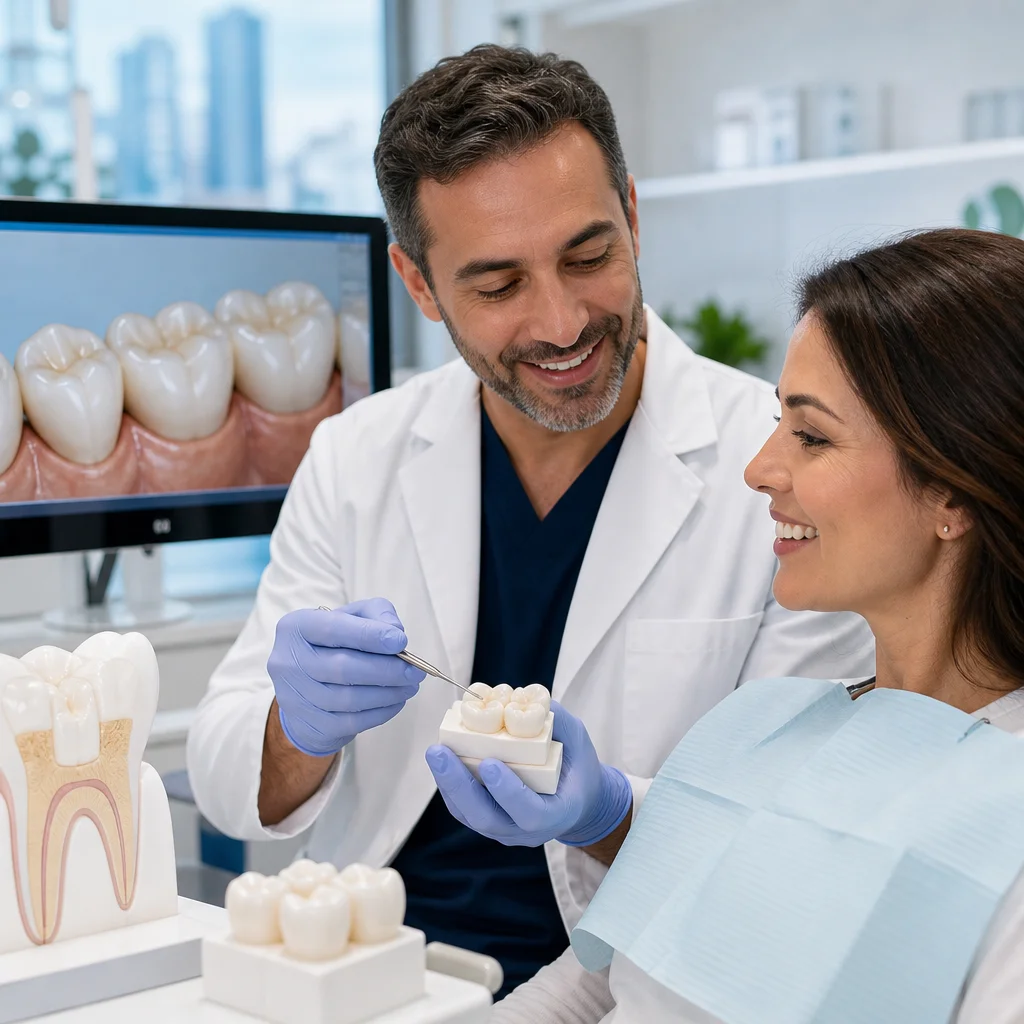
Porcelain inlays and onlays change this trajectory entirely. Because the ceramic material bonds directly to your tooth through a specialized adhesive process, it becomes part of the tooth itself. The restored tooth develops the durability of a single cohesive unit rather than a filling sitting in a prepared cavity.
When properly placed and maintained, porcelain inlays and onlays frequently last 20 to 25 years or longer. We’ve seen patients return decades after their initial restoration with the inlay or onlay still performing beautifully. This longevity means fewer replacement procedures, less cumulative tooth removal, and a restoration that truly stands the test of time.
The strength of porcelain also matters. It doesn’t expand and contract with temperature changes the way metal fillings do. This stability prevents the micro-gaps that form around traditional fillings and allow bacteria to infiltrate the tooth again. Your restoration stays sealed and protected.
Your action step: If you have older fillings that are failing or showing signs of decay around the margins, ask Dr. Edderai about replacing them with a porcelain inlay or onlay. One well-placed restoration now can protect your tooth for the next two decades.
4. Precision Digital Technology Ensures Perfect Fit Every Time
The success of an inlay or onlay depends entirely on the precision of the fit. If there are gaps between the restoration and your tooth, bacteria will colonize those spaces and cause new decay. If the restoration is even slightly misaligned, it can create bite problems or feel uncomfortable.
This is where advanced digital technology makes all the difference. At Smile Expert Design Center, we use X-MIND PRIME 3D digital imaging to capture an exact three-dimensional model of your tooth and the prepared cavity. This technology eliminates guesswork and traditional impression materials that can shift or distort.
Our digital workflow also incorporates SOPROLIFE decay detection, which uses advanced light-based imaging to identify areas of decay or structural weakness that might not be visible to the naked eye. This ensures we prepare your tooth with absolute precision, removing all decay while preserving every possible millimeter of healthy structure.
The digital images and detection data are then used to design and mill your restoration with micron-level accuracy. Every contour, every contact point, and every marginal edge is calculated and crafted to fit your tooth perfectly. The result is a restoration that seats completely, contacts your bite ideally, and functions as if it were your natural tooth.
Your action step: Ask us to show you the 3D digital model of your tooth during your appointment. Seeing exactly how your restoration will fit provides confidence and transparency about the treatment plan.
5. Conservative Tooth Preservation Through Minimally Invasive Treatment
Your natural tooth is irreplaceable. Once it’s gone, no restoration can fully replicate its strength, sensitivity, and integration with your bone and gums. This is why we prioritize conservation in every treatment decision.
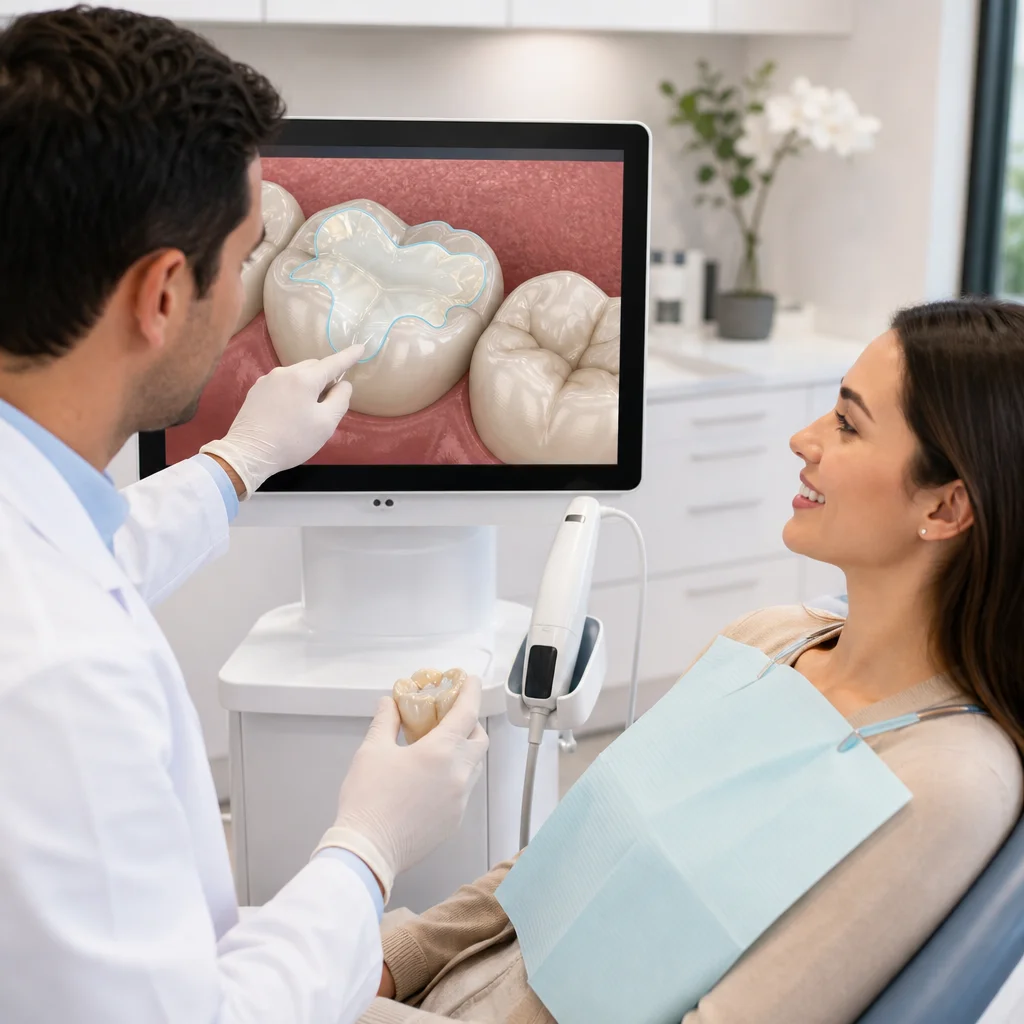
A porcelain inlay or onlay requires significantly less tooth removal than a crown. A crown typically necessitates reducing your tooth by 1.5 to 2 millimeters all the way around, removing healthy structure that will never be replaced. An inlay or onlay, by contrast, removes only the decayed or damaged portion of your tooth and the minimal amount of healthy structure necessary to provide retention.
This conservative approach delivers multiple benefits. Your tooth retains maximum strength because more of the original structure remains intact. Sensitivity issues are less likely because less of the sensitive inner portion of the tooth (the dentin) is exposed. The nerve and blood supply of your tooth face minimal stress during preparation and restoration.
Years from now, if complications arise with your original restoration, your tooth will still have substantial healthy structure available for retreatment. Compare this to a tooth that has been heavily reduced for a crown: there’s nowhere to go if that crown fails. The tooth may be lost entirely.
We view our role as stewards of your natural teeth. Every porcelain inlay and onlay we place is designed with the long-term health of your tooth at the center of our decision-making.
Your action step: During your consultation, ask Dr. Edderai to explain specifically how much of your natural tooth will be preserved with an inlay or onlay versus alternative treatments. Understanding this difference helps you make an informed choice about your oral health.
6. Cost-Effective Long-Term Solution for Moderate Decay Restoration
When you compare costs on the surface, a porcelain inlay or onlay appears more expensive than a traditional filling. But when you factor in longevity and the total cost of care over decades, inlays and onlays represent exceptional value.
A composite filling might cost $200 to $300 but will need replacement within 5 to 7 years. A porcelain inlay or onlay might cost $1,200 to $1,800 but will perform reliably for 20 to 25 years. Over a 25-year period, the traditional filling requires four to five replacements, each one removing more tooth structure and costing money. The total cost of all those fillings can exceed $1,200 or more, not including the time away from work and the cumulative damage to your tooth.
The porcelain inlay or onlay, placed once, delivers decades of protection and beauty. You’re not paying for repeated procedures, repeated anesthesia, and repeated damage. You’re investing in a permanent solution.
Additionally, porcelain restorations maintain your tooth’s structural integrity, which can prevent more serious problems down the line. A tooth that has been repeatedly filled and has lost significant structure may eventually require a root canal or extraction. A tooth protected by a well-placed porcelain inlay or onlay can maintain health and function for life.
We also understand that cost matters. We offer flexible financing through CareCredit and Lending Club, making it possible to spread the investment across manageable monthly payments. This way, you’re not choosing between your smile and your budget.
Your action step: When you come in for a consultation, ask us to calculate the total cost of care over time for different treatment options. Seeing the long-term financial picture often makes the value of a porcelain inlay or onlay immediately clear.
7. Quick One-Visit Placement with Our Advanced CEREC Technology
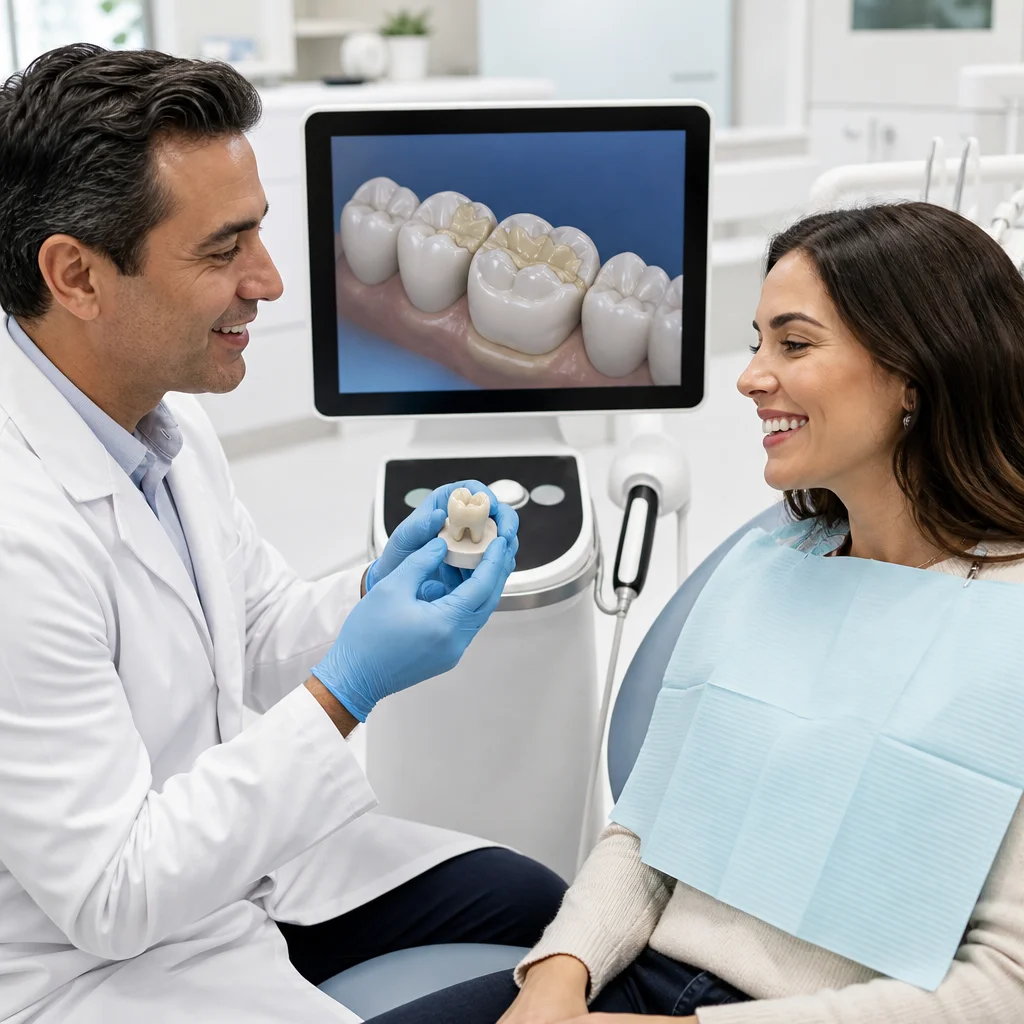
Imagine having your restoration completed in a single appointment, without temporary crowns, multiple visits, or waiting weeks for a lab. This is now possible with our CEREC technology.
CEREC uses advanced computer-aided design and milling to create your porcelain restoration while you’re in our chair. After Dr. Edderai prepares your tooth and takes a digital scan, our milling unit crafts your inlay or onlay from a solid block of high-grade porcelain. Within an hour or two, your restoration is ready for placement.
Compare this to traditional lab-based restorations, which require an impression, a temporary restoration, a second appointment weeks later, and additional visits if adjustments are needed. CEREC eliminates all of that. You walk in with a damaged tooth and leave with a complete, beautiful restoration that same day.
The same digital precision that makes CEREC inlays and onlays so accurate also makes them durable. The porcelain is milled from blocks engineered for strength, and the restoration is bonded to your tooth with the same precision we used to design it. You’re not waiting for a lab technician to hand-craft your restoration; you’re receiving a restoration milled to exact digital specifications.
For patients with busy lives, families to care for, or jobs that make multiple appointments difficult, one-visit restoration is transformative. You get your smile back immediately, with full confidence in the quality and longevity of your restoration.
Your action step: Ask us whether your specific restoration can be completed with CEREC. Most inlays and onlays are candidates for same-day completion, allowing you to reclaim your smile without disrupting your schedule.
For further reading: Dental inlays and onlays.
Frequently Asked Questions (FAQ)
What’s the difference between a porcelain inlay and an onlay, and which one do I need?
We use inlays when decay or damage affects the chewing surface between your tooth’s cusps, while onlays extend our restoration to cover one or more of the cusps themselves. During your consultation, we’ll examine your tooth with our X-MIND PRIME 3D imaging to determine which restoration will give you the best outcome and longest-lasting results.
Can you really place a porcelain inlay or onlay in just one visit?
Yes, we absolutely can. We use our advanced CEREC technology to design, mill, and bond your custom porcelain restoration in a single appointment, so you leave our North Miami Beach practice with a fully restored tooth the same day you arrive.
How long do porcelain inlays and onlays typically last compared to traditional fillings?
Our porcelain restorations generally last 15-20 years or longer, while traditional fillings often need replacement within 5-10 years. We’ve found that the precision fit we achieve with our digital technology and the durability of porcelain significantly reduces the risk of future decay and the need for retreatment down the road.